TEA Nitrogen Laser
Transverse electrical excitation at atmospheric pressure
Introduction
A TEA laser uses Transverse Electrical Excitation at Atmospheric pressure. Ordinary air contains about 78% nitrogen, which can act as the laser medium. Because the nitrogen transition has very high gain, a short atmospheric-pressure device can operate superradiantly without a conventional two-mirror resonator.
Operating Principle
Two long parallel electrodes form the discharge region. A fast, high-voltage pulse excites nitrogen molecules across the gap. The resulting ultraviolet emission is centred near 337.1 nm. The pulse is brief, and the beam usually has much greater divergence than that of a conventional resonator laser.
A reflector at one end can increase the useful output in one direction, but the device can still lase without a complete optical cavity because of the high gain of the excited nitrogen.
Electrical Arrangement
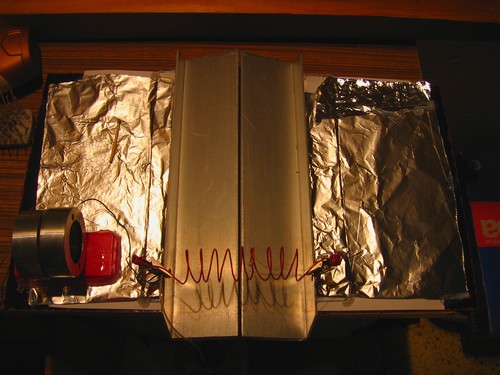
The original experimental arrangement used capacitors, a spark gap and an inductive charging path. The coil slows the redistribution of charge so that a sufficiently fast transverse discharge can form between the electrodes. The electrode gap depends on source strength and geometry; with a relatively weak source, the original experiment used a gap of approximately 0.5 mm.
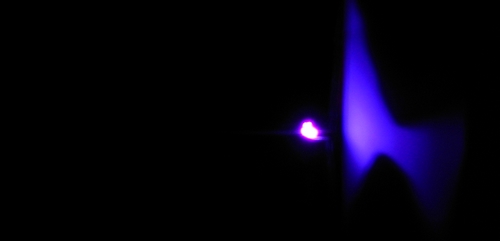
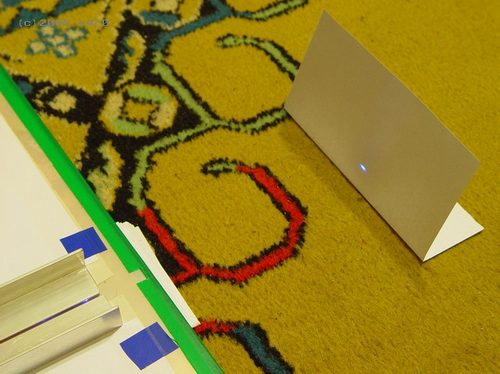
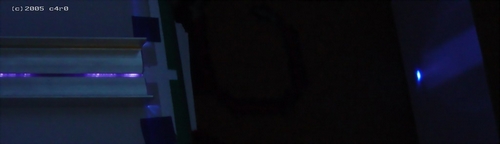
The first quick prototype used a limited high-voltage source. Later tests used improved electrodes, a mirror and a lens. The photographs document the experimental stages, circuit diagram and examples that inspired the construction.
Output and Limitations
Depending on electrode length, pulse energy and geometry, nitrogen-laser peak output may range from milliwatts to much higher pulsed values. The radiation is ultraviolet and may be poorly visible, which increases the hazard. Beam divergence is usually large unless additional optics are used.
Project Gallery