Sources of Radioactivity
Alpha, beta and gamma decay and classification of radiation sources
Introduction
Radioactivity can be divided into several principal types. The original article describes alpha, beta and gamma decay, followed by a classification of ionising-radiation sources and their geometrical forms.
Alpha Radioactivity
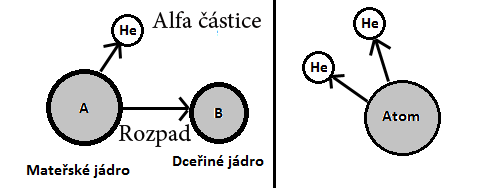
Alpha radioactivity is one of the least penetrating forms of radiation, but it has the strongest ionising effect because it removes electrons from the shells of the atoms through which it passes.
It occurs mainly in the heaviest nuclei because of their instability. An alpha particle is a helium nucleus containing two protons and two neutrons.
For alpha decay to be energetically possible, the mass–energy condition must be satisfied. The mass of the parent nucleus must be greater than the combined rest mass of the daughter nucleus and the emitted helium nucleus.
During the transmutation shown in the diagram, the parent nucleus moves two positions backwards in the periodic table and its mass number decreases by four. If the daughter nucleus is still radioactive, further transformations occur. The resulting sequence is called a decay series.
Figure 1 – Schematic representation of nuclear alpha decay.
Beta Minus and Beta Plus Radioactivity
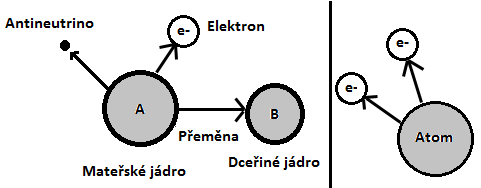
Beta-minus radiation is essentially a stream of electrons emitted from an atomic nucleus at high speed.
It occurs when an excess neutron is transformed into a proton. An electron and an antineutrino are created and emitted, while the proton remains bound in the nucleus by the strong nuclear interaction.
For beta decay to occur, the corresponding mass–energy condition must again be satisfied. During this transmutation, the parent nucleus moves one position forward in the periodic table because its atomic number increases by one.
The opposite process is beta-plus decay, in which positrons are emitted.
Figure 2 – Schematic representation of nuclear beta transformation.
Gamma Radioactivity
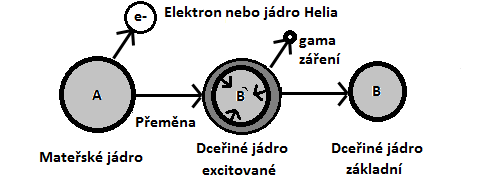
Gamma radiation is high-energy electromagnetic radiation produced by de-excitation.
In radioactive decay, the daughter nucleus may be formed in an excited energy state. It then returns to a lower-energy state and emits the energy difference as a quantum of hard gamma radiation—a photon.
Figure 3 – Schematic representation of nuclear transformation, excitation and gamma emission.
Sources of Ionising Radiation
Radiation sources can be divided into two principal groups: natural and artificially produced.
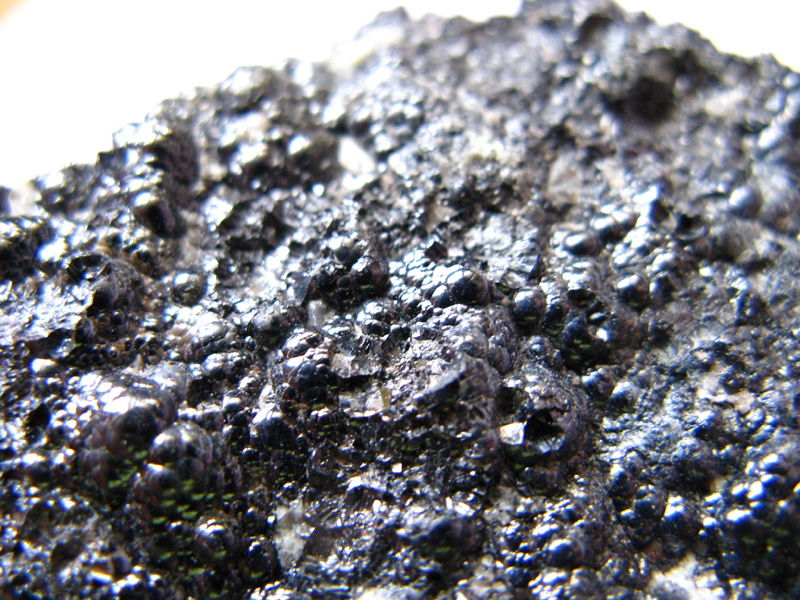
Examples of natural radionuclides include uranium, radium, radon and thorium. Artificial radionuclides include plutonium, americium and technetium.
Sources can also be classified according to their physical principle:
- Electronic sources, such as X-ray tubes.
- Radioactive sources, which emit radiation as a result of nuclear decay.
- Cosmic radiation sources.
Geometrical Classification of Sources
Radiation sources may also be classified according to their geometrical shape:
- Point sources – their physical dimensions are much smaller than the distance at which the emitted radiation is investigated.
- Line sources – the radioactive material is contained in a thin tube or wire, either inside it or deposited on its surface. A line source may be straight or bent into an arbitrary curve.
- Surface sources – the radioactive material is deposited as a thin layer over a surface, commonly rectangular or circular.
- Volume sources – the radioactive material is distributed throughout a volume, commonly a block, cylinder or sphere.
Particle Fluence
Particle fluence rate is the particle flow, or particle-flow density. It is defined as the number of radiation quanta passing in one second through a unit area positioned perpendicular to the direction of propagation.
It is expressed as particles per second per square metre:
(particles/s)/m²
Figure 4 – Photograph of a natural radiation source: uraninite, chemically approximated as UO₂, from my personal collection.
Project Gallery