Radiation Measurement
Dosimetry, Geiger–Müller counters, shielding and measurement geometry
Introduction
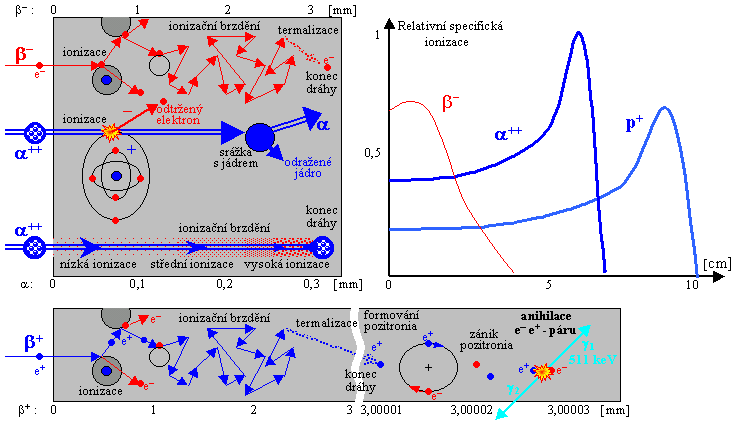
The physical properties of particles are determined mainly by their effects on surrounding materials and by their absorption in matter. These effects depend on the material, the type of particle and its energy.
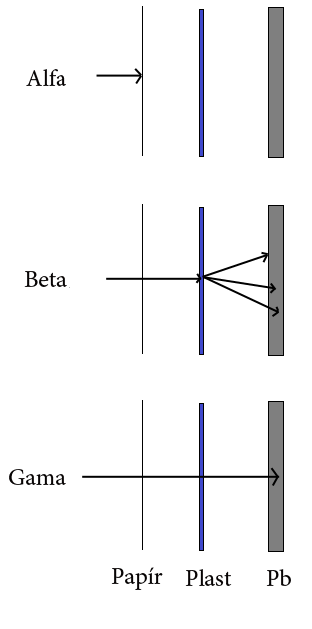
Alpha radiation has the lowest penetration. A sheet of paper, or simply a sufficient distance from the source—typically a few centimetres depending on activity—is usually enough to stop it. However, alpha radiation has very strong ionising effects.
Beta radiation is a stream of electrons and penetrates much further, in some cases by roughly two orders of magnitude more than alpha radiation. Beta radiation is best shielded by a combination of two materials. The first layer may be aluminium foil or a thin plastic sheet, followed by a layer of lead to absorb the bremsstrahlung gamma radiation produced when the electrons are stopped in the lighter material.
Gamma radiation is difficult to shield because it is electromagnetic radiation consisting of photons. A thick layer of lead or concrete is required. The interaction of these types of radiation with matter is illustrated in the accompanying diagram.
The interaction diagram was taken from Astronuklear Physics – Nuclear Medicine, which is an excellent publication and well worth reading.
Shielding
The shielding of the individual particle types was described in the previous section. The diagram provides a schematic representation of their penetration.
Alpha radiation can often be shielded simply by air, meaning by increasing the distance from the source. The intensity of radiation changes with distance. As the theory predicts and my measurements confirm, the measured intensity decreases strongly as the distance from the source increases.
Methods of Particle Detection
Particles can be detected in many different ways. Detectors may first be classified according to the time dependence of their response.
Continuous detectors provide ongoing information about the instantaneous radiation intensity or the current number of detected ionising-radiation quanta.
Cumulative detectors gradually store an increasing response during the entire exposure.
Dosimeters can also be classified according to their detection principle. This group includes photographic, material-based and electronic detectors. The following sections concentrate mainly on electronic methods.
Ionising-radiation dosimetry is a branch of radiation physics dealing with the effects of radiation on matter in relation to the types and properties of radiation–matter interactions and to the quantity of radiation absorbed in the material.
Geiger–Müller Counter
A Geiger–Müller counter provides continuous information about the instantaneous dose or dose rate. The result may be displayed in various radiation units, commonly as a dosimetric value such as mSv or mGy per unit time.
A GM counter may also display activity, or more precisely the pulse count rate. Activity itself is expressed in becquerels, while a simple counter usually reports counts per second or counts per minute unless it is calibrated for a specific source and geometry.
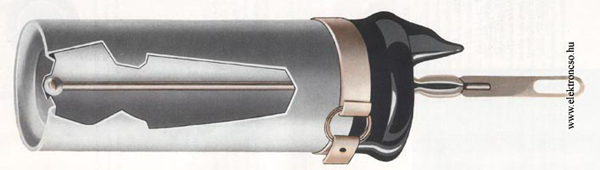
The main component is the Geiger–Müller tube. Its construction resembles a low-pressure discharge tube, but its envelope and window are designed for the radiation type to be detected. Nitrogen or argon is commonly used as the main fill gas, together with a small amount of a halogen vapour such as bromine. The halogen rapidly quenches the discharge created after detection of a particle, while the main gas provides suitable conductivity and avalanche behaviour.
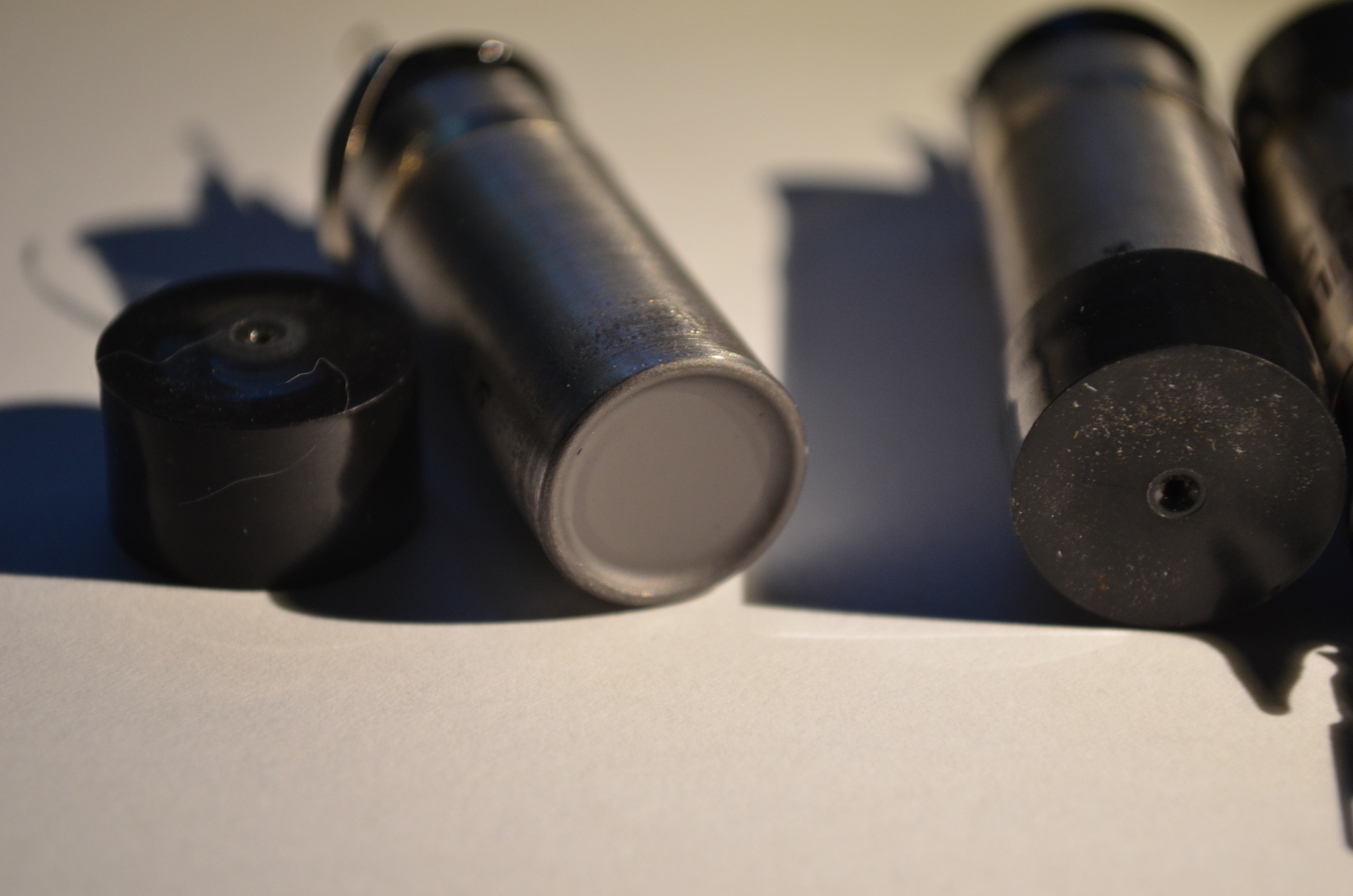
Depending on the type, a GM tube operates at approximately 200–1,500 V. The photograph shows the tube used in my instrument.
Appropriate shielding from the natural radiation background may also be necessary. For this purpose, tubes can be installed in cylindrical probes with lead shielding.
Every GM tube has a dead time (DT). This determines the maximum count rate that can be recorded. In a simplified form, the maximum theoretical count rate is approximately 1 / DT. During the dead time, the tube is recovering from the previous discharge and cannot register another particle.
Measurement Geometry
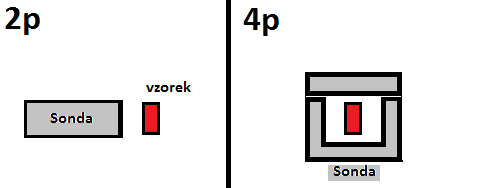
Correct measurement of activity or dose rate requires a defined measuring geometry. Common arrangements are 2π (180°) or 4π (360°), and measurements are often performed at a distance of approximately 1 cm from the sample.
The radiation intensity from a radionuclide is directly proportional to the activity of the source and inversely proportional to the square of the distance from the source.
Equations for Absolute Measurement
The absolute activity can be expressed as:
A [Bq] = F · (N − Np) / t
where F is a correction factor incorporating several additional coefficients:
F = fg · fd · fa
fg = 4π / ω is the geometrical factor, determined by the ratio between the full solid angle 4π and the actual solid angle ω in which the quanta emitted by the source enter the sensitive volume of the detector.
fd is the correction factor for detection efficiency. It depends on the type and size of the detector, the type and energy of the radiation and, where relevant, the detector dead time.
fa is the correction factor for radiation absorption. It is the product of factors describing self-absorption in the sample, absorption in the detector window and possible absorption in the medium between the source and the detector.
These correction factors must be determined independently for every specific measuring arrangement.
Dosimetric Quantities
Dose rate Ḋ is the dose received by an irradiated material at a given location per unit time.
The radiation dose D from a radioactive source may be written in simplified form as:
D = Γ · A · t / r²
where A is the source activity, r is the distance from the source and t is the exposure time.
The coefficient Γ is the dose constant or gamma constant. It gives the dose rate at a distance of 1 m from a radioactive source with an activity of 1 Bq.
Its basic unit is Gy·m²·Bq⁻¹·s⁻¹, although the practical unit mGy·m²·GBq⁻¹·h⁻¹ is often used.
The gamma constant includes the radionuclide properties, especially the number of photons emitted per decay, their energies and the corresponding absorption in the irradiated material such as water or soft tissue. Therefore, every radionuclide has a different value.
Typical values in mGy·m²·GBq⁻¹·h⁻¹ include approximately:
- 137Cs: Γ = 0.077
- 60Co: Γ = 0.308
- 131I: Γ = 0.052
- 99mTc: Γ = 0.016
The dose equivalent H in a given tissue is the product of the absorbed dose D and the quality factor Q:
H = Q · D
It is expressed in sieverts, often as a dose rate such as mSv/h. The quality factor is approximately 1 for beta and gamma radiation and approximately 20 for alpha radiation.
Project Gallery