
Solid-State Tesla Coil (SSTC)
Transistor-driven resonant Tesla transformer
Introduction
After a long break, I began building another Tesla coil. I had already wound a secondary coil 37 cm high and 7.5 cm in diameter, with an expected resonant frequency around 250 kHz. This relatively low frequency is suitable for transistor drive because power semiconductors become increasingly difficult to cool as switching frequency rises.
Solid-State Drive Principle
To induce a very high voltage in the secondary, the primary is driven with a large, fast-changing voltage, often several hundred volts. The switching waveform should be close to rectangular and its frequency must track the secondary resonance. Suitable resonant capacitors, fast power transistors and powerful gate-driver circuits are required. Good gate drive produces steep switching edges and reduces transistor heating.
Second SSTC Attempt
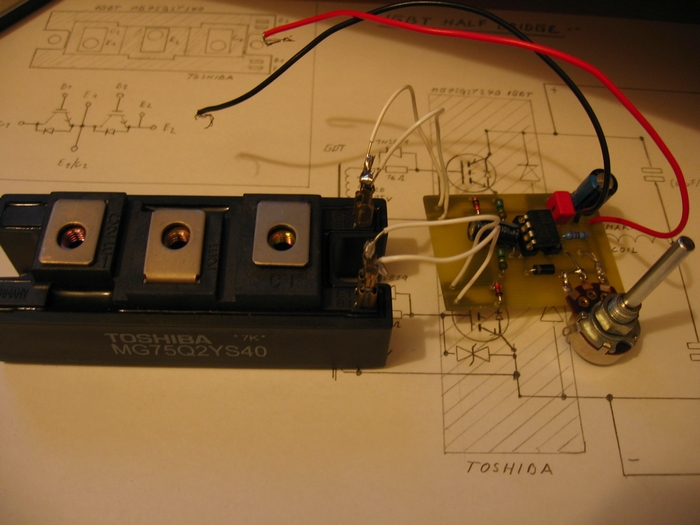
After initial tests, I built a new two-layer PCB designed in Eagle. The driver uses a CD4046 phase-locked loop, with controlled modulation from the mains waveform to improve discharge stability. Schmitt-trigger gates from a 74HC14 improve the signal shape. Delay circuitry creates safe non-overlap between the two gate-drive signals.
Texas Instruments UCC37321 and UCC37322 drivers provide peak gate currents of approximately 9 A. Galvanic isolation between the control electronics and power stage is provided by a gate-drive transformer (GDT). The photographs show operation at only 35 V. After obtaining a better GDT, improved transistors and additional protection, the intended next step was operation from a rectified mains bus of approximately 380 V DC.
Development Notes
The design requires careful dead-time adjustment, shielding, grounding, over-current protection and thermal management. The GDT core, turns ratio and winding symmetry strongly influence switching quality. This page documents the experimental development stage rather than a finished commercial design.
Project Gallery